Earth Sandwich / City antipodes / Moscow
Antipode finder · Russia
The antipode of
Moscow.
Draw a straight line from Moscow (55.75° N, 37.62° E) through the centre of the Earth and it comes out at 55.75° S, 142.38° W, in the South Pacific Ocean, 2,059 km from the nearest dry land, off the coast of Antarctica. The other slice of an Earth sandwich would sink.
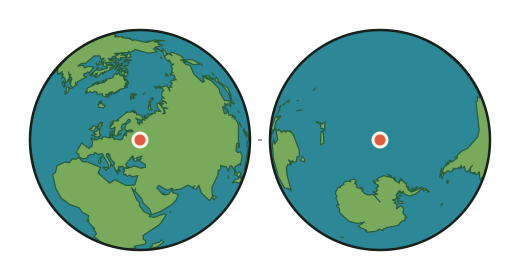
- Moscow
- 55.75° N, 37.62° E · about 120 m above sea level · 10,381,222 people
- Antipode
- 55.75° S, 142.38° W
- What is there
- The South Pacific Ocean; the sea floor there lies about 3,320 m below the surface
- Nearest dry land
- 2,059 km from the antipode, on the coast of Antarctica
- Nearest town
- Waitangi, New Zealand · 2,740 km from the antipode
- Nearest big city
- Auckland · 3,817 km from the antipode
- Sandwich verdict
- SOGGY the other slice lands in open water
- Nearest exact spot
- 2,666 km away, near Réville, France ⇄ 730 km from Waitangi, New Zealand
Can you make an Earth sandwich from Moscow?
No, not from Moscow itself. The other slice would land in the South Pacific Ocean, 2,059 km from the nearest dry land (Antarctica), where the sea floor lies about 3,320 m below the surface. Boats do not count (Sandwich Law § 1.3).
The nearest place from which an exact Earth sandwich is possible is 2,666 km from Moscow, 7 km from Réville, France. Its other slice would go down 730 km from Waitangi, New Zealand.
How this was worked out: the antipode flips the latitude and moves the longitude by 180°. Land or sea comes from the OpenStreetMap coastline the map uses; the sandwich verdict and elevations come from the verifier's 0.2° grid (Natural Earth land, ETOPO 2022 relief); water names from Natural Earth; towns and populations from GeoNames. The city's position is GeoNames' point for it; a big city's suburbs spread tens of kilometres around that point, and the figures move with them. Generated 2026-09-29.