International Sandwich Authority · Press office
For the
press.
Everything you need to know in order to write about Earth Sandwich: the story in one paragraph, the figures and where they come from, the history since 2006, images you can use, and a person to ask.
- What
- A free website that finds the exact opposite point of anywhere on Earth, and a record board for people who put bread on both.
- Where
- earth-sandwich.com, in English, Spanish, French, Chinese, Indonesian and Portuguese.
- Who
- Laurent Georges, in Switzerland. A non-commercial hobby project: no ads, no accounts.
- Contact
- [email protected]
The story in one paragraph
In 2006 the internet artist Ze Frank asked his viewers to make an Earth sandwich: two people put a slice of bread on the ground at exactly opposite points of the planet, at the same moment, so the whole Earth is the filling. It is harder than it sounds, because most land has ocean on its far side. Earth Sandwich is the map, the rulebook and the record board the challenge never had. Tap any spot and it shows where your other slice would land, whether it lands on land, and who lives nearby; a lobby lets two people on opposite sides time their bread to the same minute, and verified sandwiches go on a public board, ranked by how high both ends are.
The numbers, and where they come from
- Land opposite land. 13.5% of the world’s land, and 3.9% of the whole surface, has dry land at its exact antipode; 34.5% of land is within 200 km of a match. Measured from OpenStreetMap’s coastline, on an equal-area projection. The zones map and its method.
- Who lives opposite land. 975 million people in China (69% of the population), 231 million in Indonesia, 13 million in Spain and 89% of New Zealanders live on land with land exactly opposite; so does everyone in the Philippines, Malaysia, Hawaii, Fiji, Samoa and Tonga. Population from the EU’s GHS-POP 2020 grid. The ten corridor guides.
- Cities that are each other’s antipode. Of all cities over 100,000 people, the closest pairs are Padang ↔ Esmeraldas (1.4 km off), Batu ↔ San Fernando de Apure (2.2 km) and Palembang ↔ Neiva (3.2 km), all in the Indonesia–Colombia corridor. Wuhan and Hefei each have an Argentine town within a kilometre of their antipode (China–Argentina). A town in Peru called Asia is 841 m from the antipode of Moung Ruessei, Cambodia (Vietnam–Peru).
- The highest-scoring pair in our data. The Board scores a sandwich by the height of both ends added together. The best pair of cells on Earth joins the mountains of Kon Tum, Vietnam, with the Andes near Orcopampa, Peru: +6,320 m. China–Argentina is second, at +6,160 m.
- Famous pairs. Madrid’s antipode is in New Zealand’s North Island, about 30 km from Dannevirke; Auckland’s is in the hills near Ronda, 5 km from Setenil de las Bodegas. Beijing’s is in northern Patagonia; Honolulu’s is in the Kalahari, in Botswana. Any city: 564 city antipode pages.
- Thickness. Every Earth sandwich is 12,742 km thick, the Earth’s mean diameter, by Sandwich Law; the real figure varies by about 40 km between the poles and the equator.
Twenty years of Earth sandwiches
- 16 May 2006Ze Frank issues the challenge on his daily video blog, the show with zefrank.
- June 2006The best-known answer that year: two brothers drive into Spain with a GPS and a baguette, while a viewer in Auckland lays the other half in a front yard.
- January 2020A University of Auckland student and a chef near Ronda, in Spain, who met on Reddit, make one with laser-etched bread. The BBC, the Guardian and RNZ report it.
- November 2024The Asunción Times organises a Paraguay–Taiwan sandwich for World Sandwich Day, between the Paraguayan Chaco and Hualien.
- 2026Earth Sandwich opens: the map, Sandwich Law, the lobby for timing both slices, and the Board, which is waiting for its first verified sandwich.
Ze Frank’s own sandwich page and its antipode finder are no longer online. Earth Sandwich maps and extends his idea; it is not affiliated with him.
Screenshots and maps
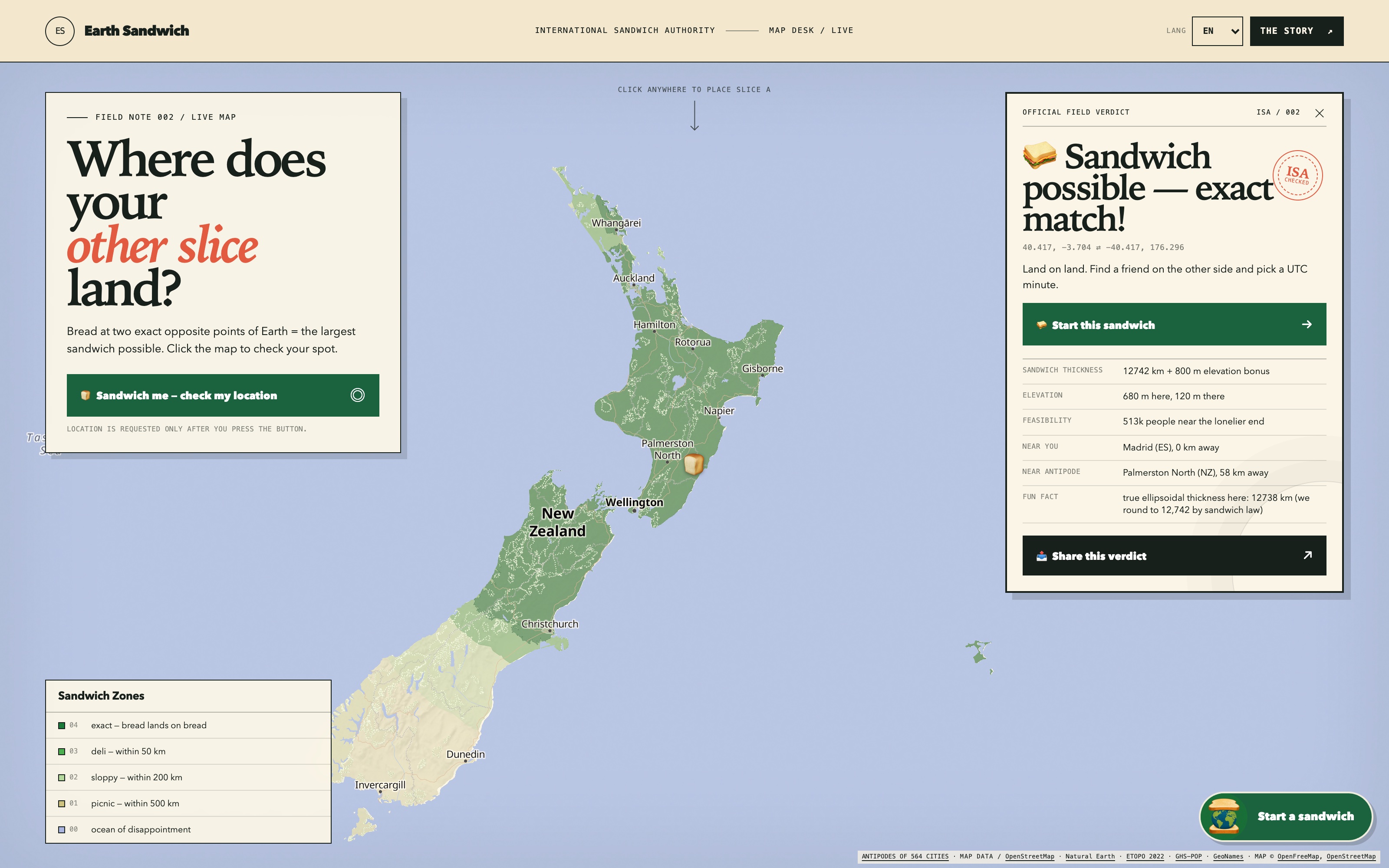
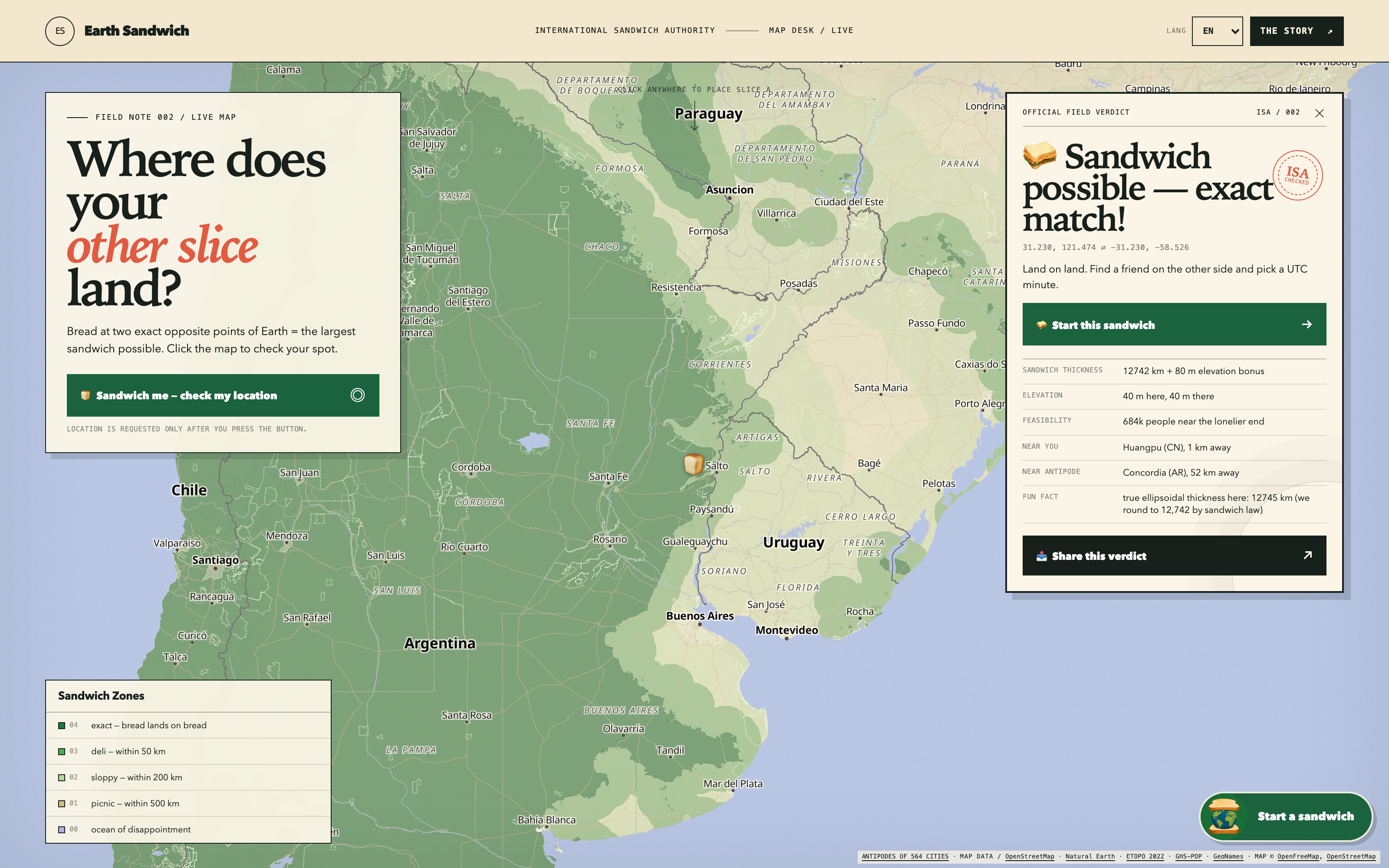
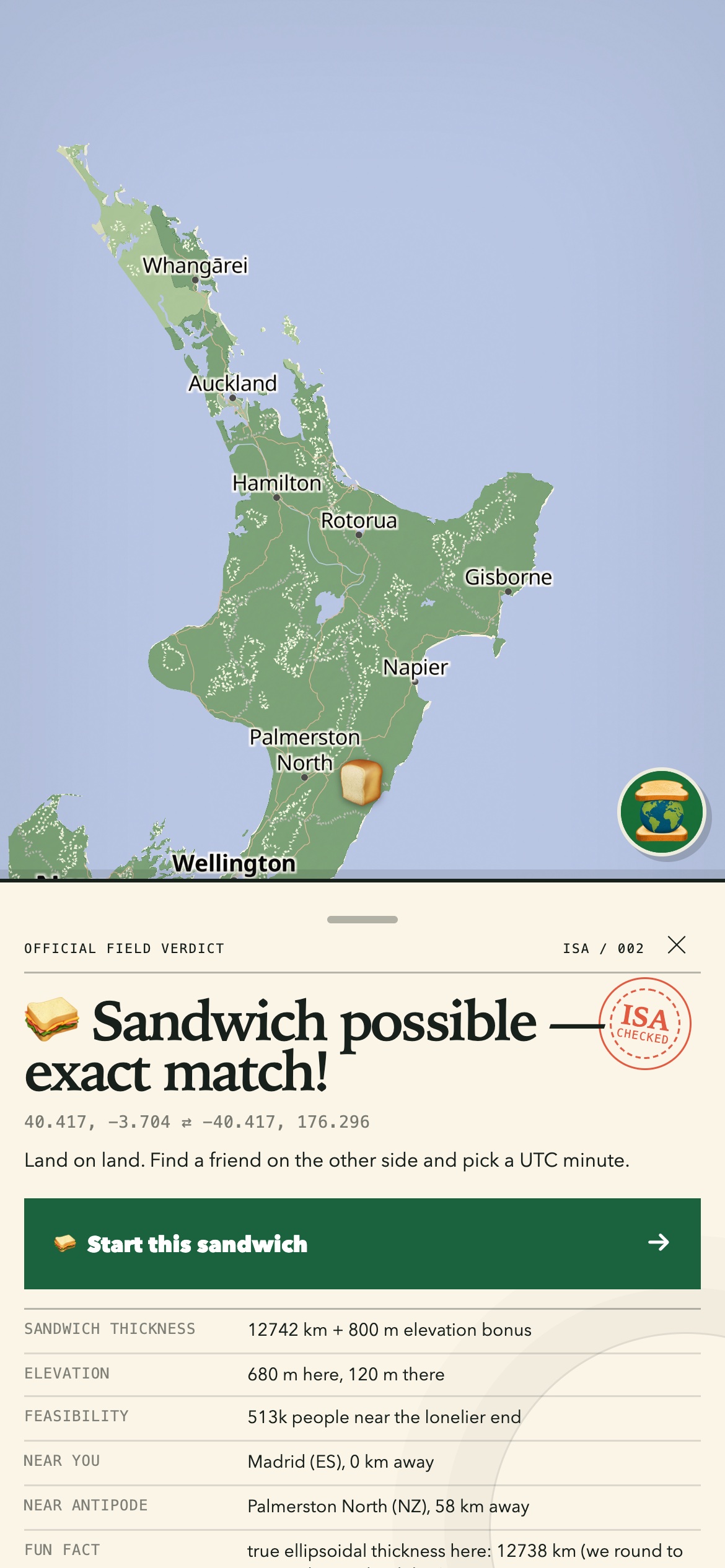
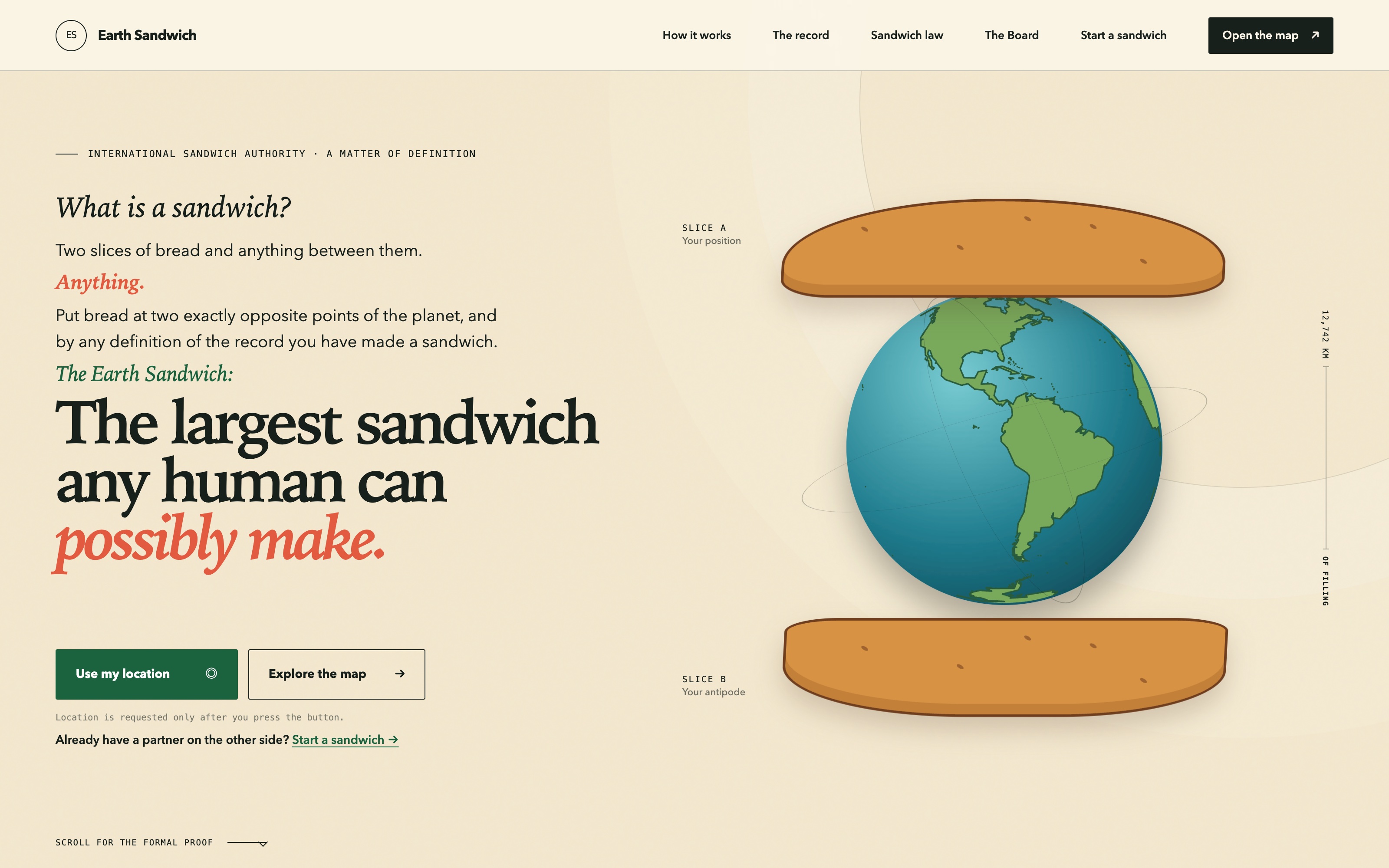
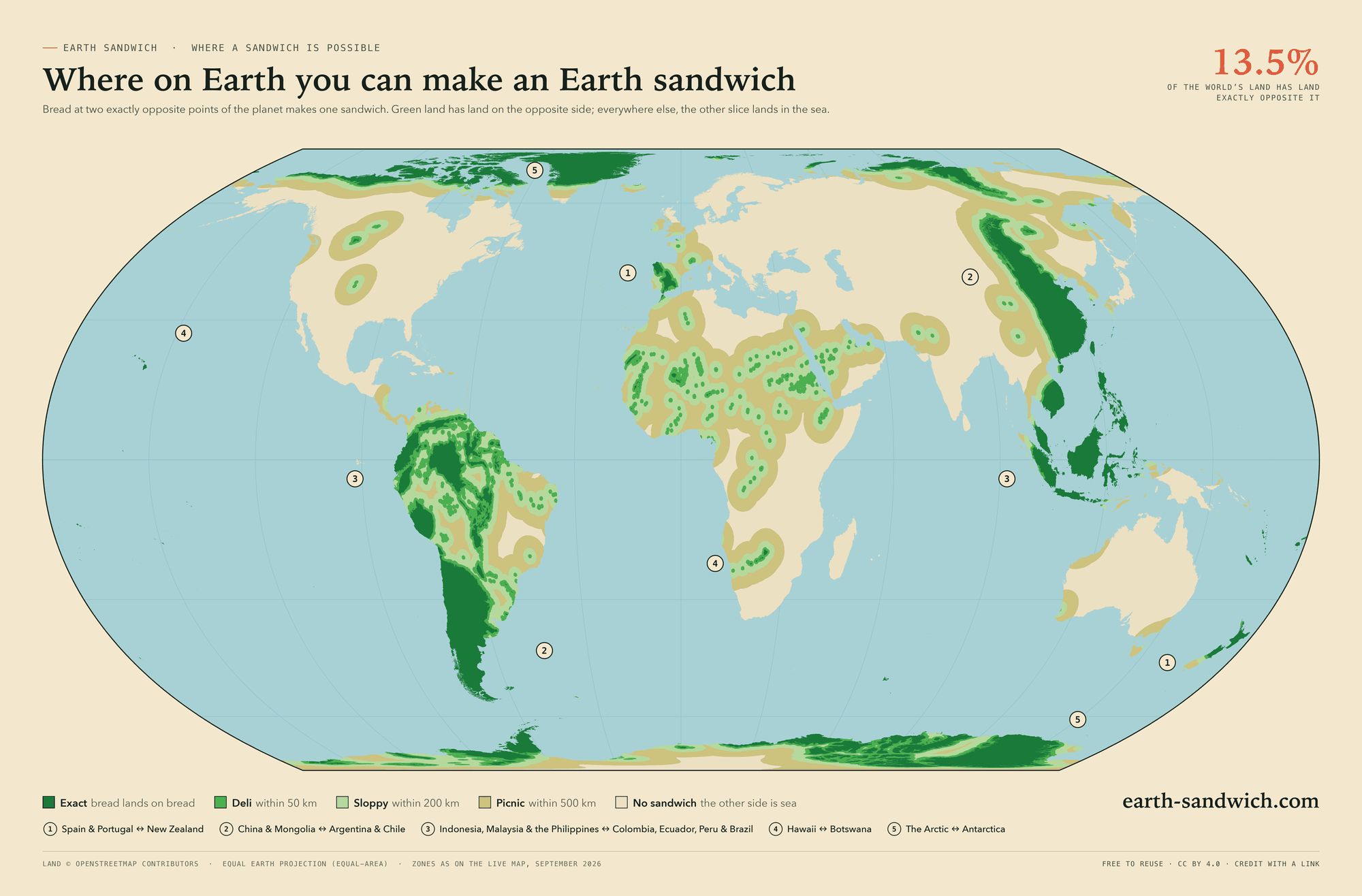
Use any of these in coverage of Earth Sandwich without asking. The screenshots are © Earth Sandwich; please credit “Earth Sandwich” and, online, link to earth-sandwich.com. The zones maps are CC BY 4.0, free for any use with the credit given on their page. The basemap in the screenshots is © OpenStreetMap contributors, via OpenFreeMap.
How it works
- The map flips any point to the other side of the Earth (latitude changes sign, longitude moves 180°) and grades the result: exact when the bread lands on land, then deli (within 50 km of land), sloppy (200 km) and picnic (500 km). The answer is worked out in the browser; the site never receives your location.
- The lobby lets two people who have found each other share a code, agree a UTC minute and photograph their bread. It does not find partners for people.
- The Board lists sandwiches that pass automatic checks on position and time (both slices within five minutes, GPS accuracy counted against the entrant) and a human moderator. Published positions are rounded to about a kilometre and photos are stripped of metadata.
- The data is open: OpenStreetMap for land, Natural Earth, ETOPO 2022 for elevation, GHS-POP for population and GeoNames for places, credited on the map.
Getting it right
- The idea is Ze Frank’s, from 2006. Earth Sandwich maps and extends it; it did not invent it.
- “The largest sandwich any human can possibly make” is a joke about geometry. It is not a recognised world record, and the Board’s rankings are “highest-scoring in our data”.
- The site finds your antipode; it does not match you with a stranger on the other side.
- The Board publishes no names, and the site does not collect them, so it cannot put you in touch with a sandwich maker.
Ask a person
Laurent Georges runs Earth Sandwich from Switzerland. For an interview, or figures for a particular city or country, write by email.